Financial Services About us Partner with us Locate & Contact us Rradar Sign in
Issue · November 2026

It's not the rate.
It's the repayment.

On Melbourne Cup Day the Reserve Bank lifted the cash rate to 4.85% — the fifth increase this year and the highest since 2008. Most of the commentary will focus on the rate itself. We think the more important number is how much of a household's income now goes to the mortgage, and what that means for spending, business cash flow and facility reviews.

This month at RION

Five things worth your time.

Market Update

It's not the rate — it's the repayment.

The headlines this week are all about the cash rate. But the number we'd point clients to is this one.

Mortgage repayments as a share of household income, median-priced home, 1984 to 2026 Repayments peaked at 37.5% of household income in December 1989, when mortgage rates were around 17%. By June 2026 they had climbed back to 35.5%, the highest since 1989, with rates under 7%. The GFC peak was about 33%; the low was about 16% around 2000. MORTGAGE REPAYMENTS Median-priced home · share of household income 20%30%40% DEC 1989 37.5% rates ~17% JUN 2026 35.5% rates under 7% 1990200020102020 1989 level · Source: REA Group data via the AFR, 3 Nov 2026
The June 2026 reading of 35.5% is the highest since 1989 (ABC, 5 September 2026).

On REA Group's measure, repayments on a median-priced home took 35.5% of household income in June — the highest share since 1989. With this week's rise, REA estimates it at around 37.4%, effectively level with the record of 37.5% set in December 1989 (The Adviser).

The difference is what's driving it. In 1989 mortgage rates were around 17%. Today they're under 7%. The issue isn't the rate on its own — it's the size of the debt relative to income. House prices have grown far faster than incomes over the past 35 years, so loans are much larger, and every 0.25% now takes a bigger bite out of the household budget.

“

A rise that looks modest in headline terms is landing on households already carrying close to record repayment loads.

That's why this cycle feels different — and why the effect is flowing so quickly into spending, which is where our business clients come in.

The rest of the RBA's message

01
Inflation is sticking around

Inflation is expected to stay above 3% through the coming year and isn't forecast to reach the top of the 2–3% target range until late 2027 (RBA statement).

02
Unemployment is rising

Unemployment has started to rise, and is now forecast to rise further than previously expected.

03
Banks are passing it on

NAB and Westpac are passing the increase on in full from 13 November, and the other majors are likely to follow.

04
Much of it is still to be felt

Rate rises take 12 to 18 months to fully flow through, so much of this year's 1.25% is still to come. Economists are divided on what's next — some expect a hold over summer, others haven't ruled out further increases in early 2027. The RBA meets again on 8 December.

↑ Back to top
Commercial Focus

When customers tighten their belts.

That repayment burden flows straight through to spending. CommBank's economists now expect annual household spending growth to slow from 1.8% to around 0.7% by mid-2027, with higher fuel costs leaving less for everything else. Discretionary spending is usually the first to give — eating out, entertainment, travel, home improvements and non-essential retail and services.

Softer sales & thinner margins

Particularly in retail, hospitality, trades and consumer-facing services.

Slower-paying customers

B2B businesses often feel it a quarter or two later, as pressure moves down the supply chain and debtor days stretch.

Higher funding costs

At the same time, variable business loans and overdrafts are moving with the cash rate.

There's also a structural change to factor in. With Payday Super in place since 1 July, super now leaves the account with every pay run rather than quarterly. For businesses that relied on that timing gap, the cash cycle has already tightened.

What we're doing about it

01
Put working capital in place before it's needed

The best time to arrange a working capital facility is while the most recent financials still look strong. Depending on the business, that could mean invoice or debtor finance, trade and import facilities, or a right-sized overdraft. It can also mean matching debt to its purpose — terming out an overdraft that has quietly become permanent, or funding equipment through asset finance rather than cash reserves.

NAB's Managing cash flow and tax hub is a useful one to share with clients — it includes a cash flow template, break-even calculator and practical guides.

02
Stay ahead of the ATO

When cash gets tight, BAS, PAYG and super are often the first things to slip. If a client is starting to fall behind, the earlier we're involved the more options there are — an ATO payment arrangement, a refinance, or restructuring other debt to free up cash flow.

03
Not everyone is on the back foot

A slower market also creates opportunity. Well-capitalised businesses are often best placed to acquire a competitor, buy their premises or invest in equipment while suppliers and sellers are more motivated. Those conversations are just as important to have early.

↑ Back to top
Business Lending

Facility reviews — get ahead of the bank.

Many business facilities come with an annual review, financial covenants and reporting obligations. After five rate rises, softer trading and falling property values, some clients will find those covenants tighter at their next review — even where nothing has "gone wrong" in the business.

Interest & debt service cover
The same profit now has to cover a noticeably higher interest bill.
Security values
CommBank's data shows capital city home prices are down around 8% from their peak. Where a facility is secured by residential property, a lower valuation can move the LVR without the client borrowing another dollar.
Timing
A review that lands just after a softer quarter, or before the latest accounts are finalised, can tell an incomplete story.

What a proactive review looks like

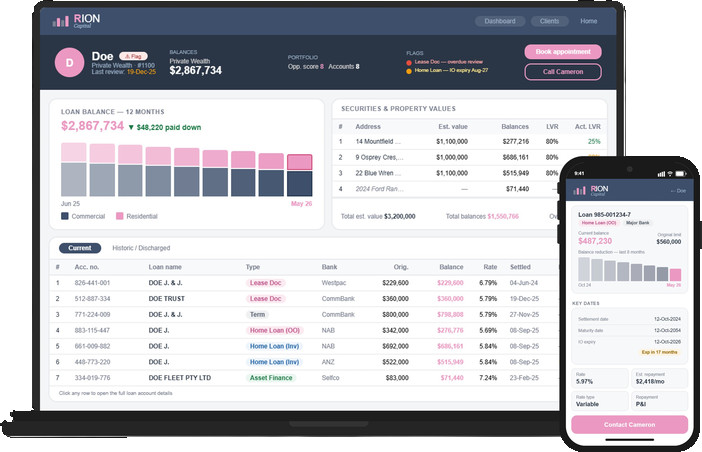
This is exactly what we built RRadar (Soon to be released) to help with. It tracks review dates, rates, LVRs and security positions across a client's portfolio, so the conversation starts months ahead rather than when the bank's letter arrives — more on that below.

Accountants and advisers usually see the numbers first. If the next set of accounts shows a dip, that's the time to bring us in — before they land with the bank's credit team.

↑ Back to top
Private Wealth

Home loans & the household budget.

Business owners are rarely just business owners. The same client managing a tighter cash cycle at work is usually also looking at a higher mortgage repayment at home. On a $600,000 variable loan, this latest rise adds around $92 a month. Across all five increases this year it's around $456 a month, or roughly $5,500 a year (ABC).

01
A rate and structure check — not just a rate check

The gap between what existing customers pay and what lenders offer new customers can be significant. Sometimes a repricing request with the current lender gets the result; sometimes a refinance does. Either way, we're also looking at structure — offset accounts, splitting between fixed and variable, loan terms, and whether personal and business debt are sitting in the right places.

02
Fixed-rate expiries & the refinancing reality

Clients rolling off a fixed rate will feel the whole rate cycle in one hit when they revert to variable. Higher rates have also reduced borrowing capacity, and lower property values can affect LVRs — so refinancing isn't automatic, and in some cases staying put and repricing will be the better outcome.

If a client is already finding repayments hard, speaking with their lender before a payment is missed makes a real difference.

“

Sometimes the right recommendation is to change nothing. We just want that to be a deliberate decision rather than a default.

↑ Back to top
RRadar dashboard — your finance, live
RRadar · Soon to be released

A look at what's coming.

Earlier this year we introduced RRadar (Soon to be released), our proprietary client engagement platform. We've been using it inside the business, and it's already changing the way we work.

RRadar was designed and built in-house — it's ours. Its purpose is simple: to give us a clear, continuous view of our clients' lending so we can go to them with opportunities, rather than waiting for them to come to us.

For the clients you introduce to us, that means their lending doesn't stop being looked after at settlement. It's monitored and reviewed over time, and we can bring you into the conversation when something changes.

We're now working through the legal and regulatory requirements to open RRadar to clients directly. Our clients' financial information deserves the highest standard of care, so we're taking the time to get privacy, security and compliance right. We'll let you know as soon as client access is ready.

We're excited about RRadar. We believe it will change the way brokers work with their clients, and we're proud it's been built here, by us, for the clients we share.

Client access · Coming soon
↑ Back to top

Let's catch up.

With December around the corner, now's a good time to connect before the end-of-year break. The clients most likely to benefit from a conversation are the ones who haven't asked for one yet — the business with a review coming up in the new year, the client coming off a fixed rate, or the owner who's noticed customers paying a little slower. Got a scenario you're unsure about? Give us a call — it doesn't need to be fully formed.